

Select Page
Posted by Evelyn Van Pelt | Oct 8, 2026 | Football
OXFORD, Miss. — Ole Miss has spent the past week confronting what went wrong at Florida. Saturday in Nashville, the Rebels get their first opportunity to show that the difficult film sessions, physical practices and renewed emphasis on fundamentals have produced more than a good response in the meeting room.
Vanderbilt presents a different offensive challenge than the one Ole Miss faced in Gainesville, but the questions for the Rebels remain familiar. Can they finish tackles? Can they account for a quarterback in the running game without losing track of receivers? And can they maintain their discipline after halftime?
For Pete Golding’s team, this matchup is an opportunity to demonstrate progress in the areas that contributed to the 52-28 loss to Florida. The defense does not need to reinvent itself in Nashville. It needs to execute its responsibilities more consistently, starting with the first contact and continuing through the final possession.
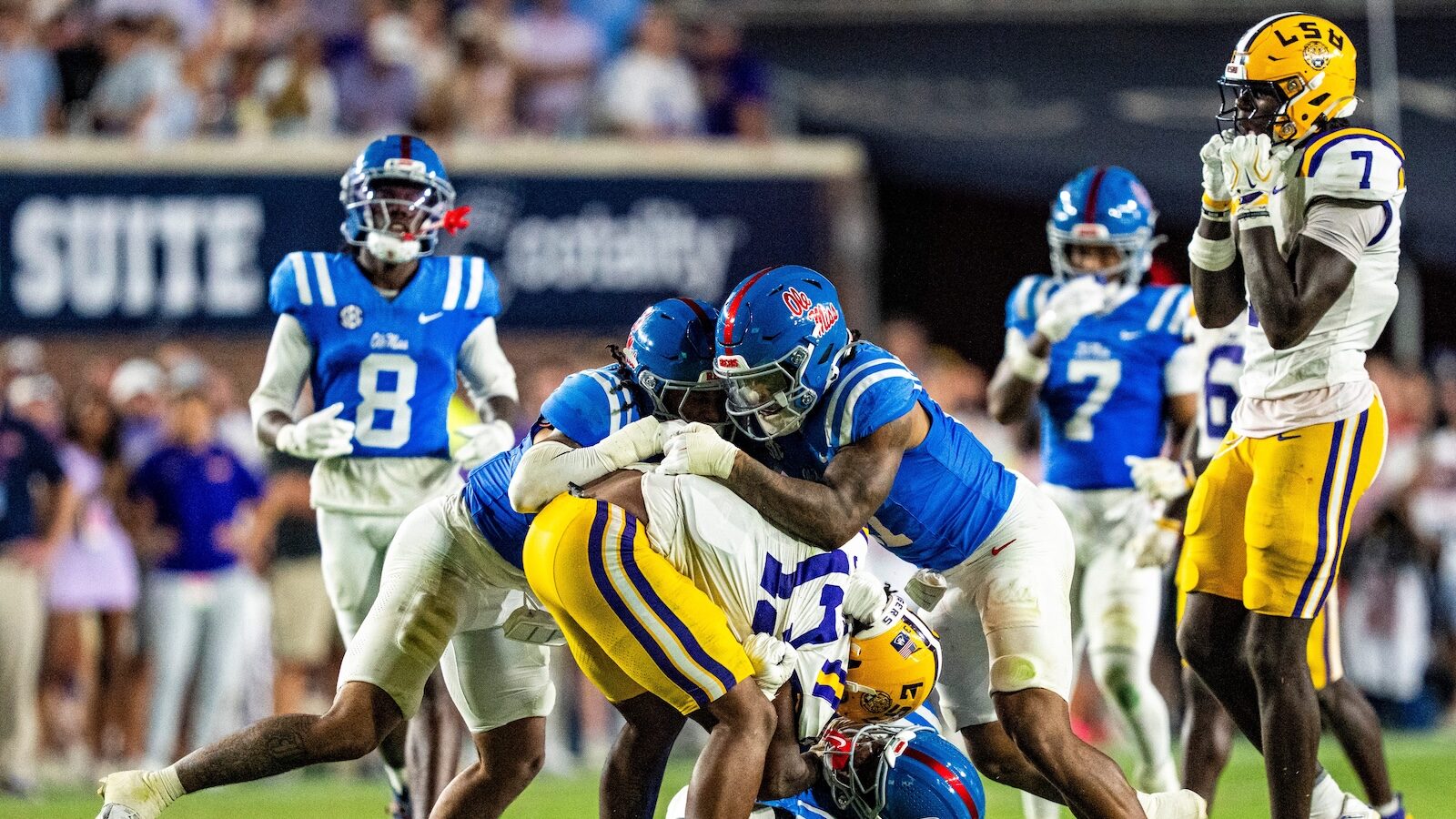
Golding identified 62 missed tackles through the Rebels’ first four games, making it clear why the open week became a return to physical work. Ole Miss put on the pads, went live and reviewed the Florida performance as a team, reinforcing both technique and accountability.
Ole Miss is allowing 194.8 rushing yards and 404.8 total yards per game, with opponents averaging 4.6 yards per carry. Those figures put too much pressure on a defense that needs to create more unfavorable situations for opposing offenses. Against Vanderbilt, improvement should be visible in ordinary plays. A defender meeting a runner near the line of scrimmage needs to finish rather than allowing the play to become a productive gain. When the first tackler cannot complete the stop, the next defender needs to arrive under control and close it out.
That requires more than delivering a harder hit. Better angles, proper leverage and multiple defenders pursuing the football can prevent one missed tackle from turning into an explosive play. The Rebels’ physical response will mean little if it comes at the expense of their assignments.
The Commodores enter Saturday averaging 123 rushing yards per game and 3.7 yards per carry. Sedrick Alexander leads the backfield with 200 yards and four rushing touchdowns, while Makhilyn Young has added 134 yards and a score.
Those totals suggest an opportunity for Ole Miss to establish control up front. They also give Vanderbilt a reason to test whether the Rebels have corrected their problems. An offense that has struggled to generate consistent rushing production can gain confidence quickly if early contact fails to stop the ball carrier.
The defensive front needs to hold its position, keep linebackers from being swallowed by blocks and avoid creating open lanes through overaggressive movement. For players such as Will Echoles and Kam Franklin, the first responsibility is helping make the runner’s path predictable. That gives the linebackers a better chance to arrive in position to finish.
Keaton Thomas, Luke Ferrelli and Tah’j Butler lead Ole Miss with 29, 27 and 24 tackles, respectively. Saturday’s test is how consistently that group can turn its involvement into stops that leave Vanderbilt behind the chains.
Freshman Jared Curtis was listed as probable on Wednesday’s initial availability report after missing the Georgia game. His potential return requires Ole Miss to prepare for both Curtis and Blaze Berlowitz, with Golding emphasizing during Wednesday’s teleconference that the quarterbacks bring different styles.
Curtis has completed 64.3 percent of his passes for 746 yards, four touchdowns and three interceptions. Berlowitz has thrown for 368 yards, one touchdown and one interception, completing 54.2 percent. Both have contributed rushing yardage, so the Rebels cannot assume that identifying one quarterback eliminates the need to defend his legs.
Tah’j Butler addressed that preparation during his Tuesday press conference, explaining that the defense needs to recognize who is in the game and understand what Vanderbilt’s personnel indicates. The practical challenge is making those adjustments without hesitation. A change at quarterback cannot lead to confusion about who accounts for a keeper, who maintains the edge or who stays with a receiving threat.
On plays that include a quarterback run option, one defender abandoning his responsibility can create the opening Vanderbilt needs. Ole Miss must make the Commodores earn their yards against a defense that knows where everyone belongs.
Vanderbilt’s most productive receiving threat is Junior Sherrill, who has 28 catches for 474 yards and three touchdowns. His 16.9 yards per reception make him an important concern for a defense trying to limit the run without surrendering big plays through the air. Sherrill caught seven passes for 107 yards and a touchdown against Georgia, demonstrating that he can produce even when Vanderbilt struggles as a team.
The Rebels need to know where he lines up and communicate when formations or motion change his position. That does not require assigning him extra coverage on every snap, but it does require a plan for when the defense commits additional resources toward the line of scrimmage.
If Ole Miss safeties react too aggressively to the run, space can develop behind them. If pressure does not reach the quarterback, a receiver like Sherrill can make the defense pay. The goal is to support the run defense while keeping Vanderbilt’s leading target from finding uncontested opportunities downfield.
Jayvontay Conner also deserves attention. The tight end, who actually transferred from Ole Miss after his freshman season, has 11 catches for 126 yards and could become a useful outlet if the Rebels limit the outside receivers. Covering the first option is only part of the job; the Rebels must also close on shorter completions before they become first downs.
Vanderbilt has allowed nine sacks through five games, while Ole Miss has recorded six through four. There is an opportunity for the Rebels to disrupt the passing game, but the way they pursue the quarterback will matter. A rush that loses containment can help an offense escape a difficult down. Edge defenders need to close space without giving the quarterback an easy path outside, while interior pressure can prevent him from stepping forward comfortably.
The Rebels should also be selective about bringing extra rushers. Pressure can accelerate a young quarterback’s decisions, but it places additional responsibility on the defenders left in coverage. The best approach is one that pairs the rush with coverage capable of taking away the quick answer.
Vanderbilt has converted 23 of 68 third-down opportunities, a rate of 33.8 percent. Ole Miss opponents have converted 25 of 57, or 43.9 percent. That difference points to an important opportunity for the Rebels to change the rhythm of the game.
The work begins before third down. Winning on early downs can force Vanderbilt into situations where its options become more limited. A missed tackle on second down, however, can turn a potential passing situation into a manageable conversion opportunity. Once Ole Miss gets the Commodores into third-and-long, it needs to finish the possession. That means protecting the first-down marker, accounting for quarterback movement and avoiding penalties that erase a successful defensive play.
Vanderbilt has also converted 11 of 16 fourth-down attempts. A third-down stop may not end the challenge, particularly when the Commodores are close enough to consider keeping their offense on the field.
The Rebels have allowed 30 first-half points and 93 second-half points through four games. That disparity makes the response after halftime one of the most revealing parts of Saturday’s matchup.
“We’re trying to start strong and finish strong,” Butler said during Vanderbilt preparation. “That’s been our problem for this whole year.”
Ole Miss needs to carry its early discipline through adjustments, fatigue and changes in momentum. If Vanderbilt finds a productive concept, the Rebels must communicate the correction and execute it on the next series. If the Commodores score, the defense cannot allow one disappointing possession to become several. Golding has said the team responded well to the additional physical work. Nashville will show whether that response holds when the game demands repeated stops.
The Rebels’ rebound also depends on avoiding the short fields that make defensive possessions more difficult. Golding addressed kickoff coverage during Wednesday’s teleconference, describing it as the first play of defense and emphasizing the importance of having the right personnel on the unit.
That connection matters. Better coverage gives the defense more room to work and reduces the chance that Vanderbilt can turn a brief drive into points. Once on the field, the Rebels need to capitalize by making the Commodores sustain possessions rather than helping them with missed tackles or penalties.
Vanderbilt has scored 15 and 14 points in its two SEC games, giving Ole Miss a chance to regain defensive confidence. But those results will not make a tackle or preserve an assignment for the Rebels. The open week provided time to identify the problems and practice the corrections. Saturday requires Ole Miss to finish contact, communicate against both quarterbacks, keep Sherrill from producing easy explosives and turn favorable downs into possession-ending stops.
A strong opening quarter would be encouraging. Four quarters of sound execution would provide much stronger evidence that the Rebels have taken a step forward.
Ole Miss and Vanderbilt kick off Saturday, October 10, at 2:30 p.m. CT at FirstBank Stadium in Nashville. The game will be televised on ESPN.
Evelyn has covered sports for over two decades, beginning her journalism career as a sports writer for a newspaper in Austin, Texas. She attended Texas A&M and majored in English. Evelyn’s love for Ole Miss began when her daughter Katie attended the university on a volleyball scholarship. Evelyn created the Rebel Walk in 2013 and has served as publisher and managing editor since its inception. Email Evie at: Evie@TheRebelWalk.com
Share:
Evelyn has covered sports for over two decades, beginning her journalism career as a sports writer for a newspaper in Austin, Texas. She attended Texas A&M and majored in English. Evelyn’s love for Ole Miss began when her daughter Katie attended the university on a volleyball scholarship. Evelyn created the Rebel Walk in 2013 and has served as publisher and managing editor since its inception. Email Evie at: Evie@TheRebelWalk.com
October 18, 2024
January 25, 2021
February 6, 2019
August 21, 2024
Designed by Elegant Themes | Powered by WordPress
Subscribe to Updates
Get the latest creative news from FooBar about art, design and business.
Ole Miss defense vs. Vanderbilt offense: Rebels must turn open-week corrections into four quarters of execution – The Rebel Walk