
Record-low 2.8% of applicants admitted to Class of 2030 regular decision
Women’s Basketball: Justine Pissott selected by Indiana Fever with 25th pick in WNBA Draft
Top 10 love songs of all time
Football: Four takeaways from Vanderbilt’s Black and Gold Spring Game
Law school ranks No. 12 in 2026 U.S. News rankings
Women’s Basketball: Ava Black enters NCAA Transfer Portal
Women’s Basketball: Vanderbilt lands Mia Woolfolk in NCAA Transfer Portal
A Boogie Wit Da Hoodie, Natasha Bedingfield to co-headline 2026 Rites of Spring
Federal judge allows former student’s false arrest lawsuit against Vanderbilt to proceed
Men’s Basketball: Vanderbilt receives commitment from Ace Glass in NCAA Transfer Portal
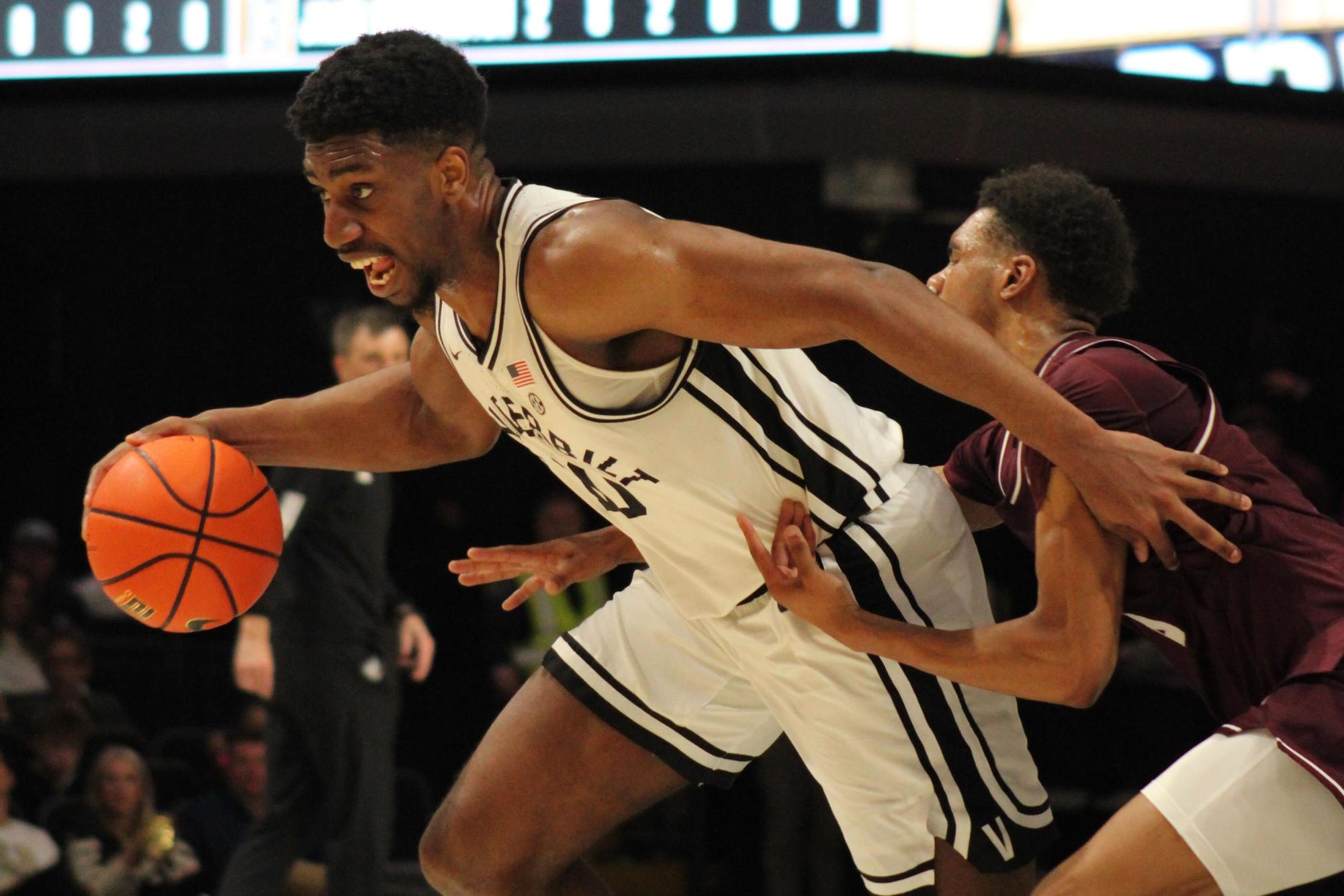
No. 19 Vanderbilt Men’s Basketball took on Texas A&M at Memorial Gymnasium on Feb. 14 in a pivotal SEC matchup. The Commodores defeated the Aggies, 82-69, improving to 21-4 overall and 8-4 in conference play.
Both teams entered the matchup looking to build momentum in the thick of SEC competition, with Vanderbilt seeking to defend its home court against one of the conference’s most physical teams. The Commodores established control early, entering halftime with a 36-32 lead despite shooting just 35.3% from the field, using rebounding and defensive pressure to generate key scoring opportunities.
Vanderbilt maintained its composure in the second half, relying on efficient free throw shooting and balanced offensive production to extend its lead and prevent Texas A&M from mounting a comeback. Despite a quiet offensive performance from star guard Tyler Tanner, Vanderbilt received significant contributions from Tyler Nickel, AK Okereke and Devin McGlockton, ultimately finishing with a commanding 82-69 victory.
Let’s dive into some takeaways from Vanderbilt’s matchup against Texas A&M.
Depth across the board
Tyler Tanner has been the engine behind Vanderbilt’s offense for much of the season, serving as the team’s primary initiator and most consistent scoring threat. However, the Commodores demonstrated their offensive versatility against Texas A&M, generating production across multiple players, even as Tanner struggled to find his rhythm with just 4 points.
Forwards Tyler Nickel and AK Okereke stepped up offensively, putting up 25 and 23 points respectively to lead the Commodores to a win.
This balanced offensive performance highlights Vanderbilt’s versatility as a team. Throughout much of the season, Tanner’s scoring often dictated the Commodores’ success, but their ability to generate offense without heavy reliance on him suggests increased depth and adaptability. If Vanderbilt can consistently produce scoring across its lineup while Tanner commands defensive attention, it significantly raises the team’s ceiling in SEC play.
Byington breaks “Bucky Ball”
Texas A&M entered the matchup relying on its signature fast-paced offensive system, “Bucky Ball,” built around tempo, high shot volume and constant pressure, aiming to overwhelm opponents by increasing possessions and generating transition opportunities. Against Vanderbilt, however, head coach Mark Byington ensured the Commodores did not allow Texas A&M to dictate the game’s speed.
Rather than engaging in a track meet, Byington’s squad showed discipline on both ends of the floor, slowing possessions and forcing Texas A&M into more controlled half court sets. Vanderbilt limited the Aggies to 38.9% shooting from the field and 27.6% from 3-point range, while finishing with a 40-39 rebounding advantage and committing just 9 turnovers. By emphasizing defensive positioning and possession value, the Commodores prevented Texas A&M from generating the chaos and transition scoring that defines “Bucky Ball.”
Byington’s ability to adjust to opposing systems reflects Vanderbilt’s continued development under his leadership. Earlier in the season, the Commodores thrived by imposing their own offensive tempo, but their performance against Texas A&M demonstrated an increased willingness to adapt based on game flow. If Vanderbilt can continue balancing its offensive aggressiveness with defensive discipline, it will be well-positioned to sustain success against contrasting styles throughout SEC play.
Winning the physical battle
Vanderbilt matched — and ultimately surpassed — Texas A&M’s physicality, controlling the glass and generating key second-chance opportunities throughout the game. The Commodores finished with 40 rebounds, including 12 offensive boards, translating those extra possessions into 15 second-chance points and helping maintain offensive consistency.
Devin McGlockton and Jalen Washington anchored the interior, combining for 16 rebounds and 5 offensive rebounds. This frontcourt production allowed the Commodores to sustain offensive pressure even when perimeter shots were contested.
Under Mark Byington, Vanderbilt has emphasized toughness and rebounding as foundational elements of its system. The Commodores’ ability to win the physical battle against a traditionally aggressive Texas A&M squad reflects the team’s continued growth and maturity. Maintaining this level of interior presence will be critical as Vanderbilt faces increasingly physical opponents throughout SEC play.
Vanderbilt will travel to Columbia next to face the Missouri Tigers on Wednesday, Feb. 18, at 8 p.m. CST.
The official student newspaper of Vanderbilt University
Your email address will not be published.
Jeff • Feb 15, 2026 at 6:39 am CST
Nice write-up on a great win! Any word on Miles or Collins?
Subscribe to Updates
Get the latest creative news from FooBar about art, design and business.
Men’s Basketball: Three takeaways from Vanderbilt’s win over Texas A&M – The Vanderbilt Hustler