
Record-low 2.8% of applicants admitted to Class of 2030 regular decision
Football: Four takeaways from Vanderbilt’s Black and Gold Spring Game
Top 10 love songs of all time
Law school ranks No. 12 in 2026 U.S. News rankings
LEE: I spent $800,000 to become less Korean
2026 NFL Draft: Eli Stowers drafted in the second round by the Philadelphia Eagles
BREAKING: Tyler Tanner declares for NBA Draft, still maintains college eligibility
Men’s Basketball: Vanderbilt receives commitment from Ace Glass in NCAA Transfer Portal
Debrief with Diermeier: Discussing a growing campus
A Boogie Wit Da Hoodie, Natasha Bedingfield to co-headline 2026 Rites of Spring
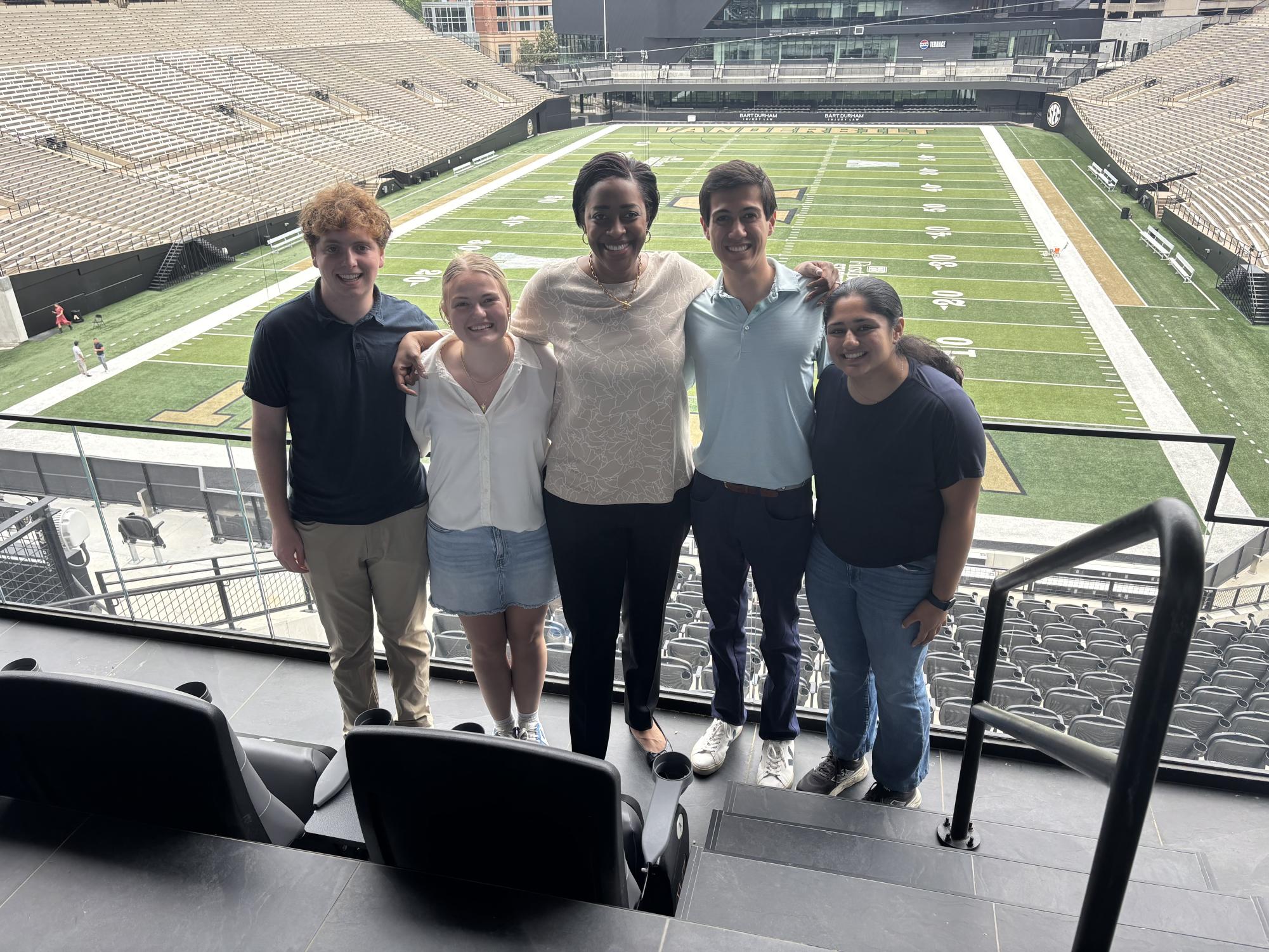
The Hustler sat down with athletic director Candice Storey Lee for its third installment of Conversations with Candice. She discussed the next stages of Vandy United as well as the House Settlement and NIL.
Lee also discussed the recent success of Vanderbilt’s athletic teams with several new coaching extensions occurring in the last few months and the recent Anchored for Her campaign.
The Hustler: The new plans for the Football Experience Center were revealed last month. When is the earliest you anticipate construction starting on that phase?
Lee: What I can tell you is that [we] know the first step, but typically, when we publicly announce a set of projects, we do it at the point [where] we at least have a solid understanding of what the order [and] the sequence of projects may be. But we’re still very much in the early processes in terms of figuring out exactly when the shovel goes in the ground because that will be dictated by the design process. We have identified the partners that we’re going to work with to do the design, and so that’s usually the trigger for the public announcement, and that’s an important trigger for fundraising.
What I can tell you is that we are being very, very aggressive. And I think if you think about what we could call the first phase of Vandy United, we moved on that very quickly. Also, I want you to think about the fact that every project has enabling steps. The Football Experience Center, which is one of the projects announced in this second phase for Vandy United, we [first] have to relocate the soccer/lacrosse stadium in order to actually execute on the Football Experience Center.
We’re working in parallel. We’re working on the design of everything, and then there will be this domino effect. I can’t give you a timeline other than to say that the shovel is going to go in the ground as soon as possible, but we are taking some interim steps.
One of those projects is the Olympic Sports Performance Center. There’s a step we’re taking towards that by relocating the Olympic sports weight room. That’s an important interim step. The reason why that’s important is because that’s going to enable us to [relocate] the current football weight room. That’s important because right now in our football weight room, our entire team cannot lift weights at the same time because it’s not big enough.
When you think about just the efficiency of time, that’s a constraint. What we’re trying to do with every single step with Vandy United is to remove constraints and improve everybody’s experience. I can tell you [that] this summer we are working on the enlarging of the relocation of the Olympic sports weight room and the football weight room, and that’s the first domino to fall.
Obviously, given the new larger footprint for football facilities on that side, The Plex stadium for soccer and lacrosse needs to be relocated. Where do you anticipate this construction occurring?
I can tell you that we are thinking through the part of the district that includes the track. There’s a rec field behind [it]. So, this would be between Blakemore and Children’s Way, the rec center footprint.
I don’t want people to hear me say we’re getting rid of the [recreation] center — we’re not. Anything from a rec center standpoint that gets displaced, we will find a new home for.
We are currently in the process of identifying additional spaces on campus where we can add fields for [recreation] center use. I do not ever want it to feel like — and I don’t want it to be the case — that Vandy United is eliminating opportunities for the broader student body.
I’m also responsible for the [recreation] center. The changes that we’re talking about this summer will also include improvements to the [recreation] center.
Has the Athletics Department thought about having some games near the new campuses in West Palm Beach, New York City and San Francisco? Would that be another way where Vanderbilt Athletics could help ensure the “One Vanderbilt” goal?
We’ve been planning that for over a year now. The answer is yes. We think athletics can be a really important driver for the One Vanderbilt approach, especially as you expand beyond the flagship [campus] here in Nashville.
For example, Women’s Basketball played in New Jersey this past January. We planned for the team to go take a picture at a new campus, and we invited James Kellerhouse, who runs the New York campus. Golf was in West Palm Beach earlier this semester. So, there are some things — we’ll absolutely look at competing in San Francisco or near San Francisco.
We think it can be very feasible to play a neutral site football game in the New York area. So, we’re just trying to find some ways.
Regarding the future renovations to the baseball stadium (beyond the new right outfield building currently under construction), a lot of fans want to know if the new renovations plans still include plans to build a “Home Run deck” with seats and a bar above the left field wall? That was a very popular feature in the original renderings.
We haven’t abandoned any plans. It’s just that we’re working on the first phase. I think that’s going to be a very cool feature in the future.
We’ve obviously seen the new outdoor tennis courts now complete. What has it meant to see that project finished and how do you think it will better the product of Vanderbilt Tennis?
We had the dedication of that project just a few weeks ago… I’ve watched it come to life right outside my window. Being on the courts and seeing it from that vantage point, it gave me chills because it gives you a very clear understanding of just what the scope is. It was also very emotional because we dedicated a court to Julie Ditty, who’s one of our greats, and it was very touching for her family. She [had] a hard-fought battle with cancer, and just to be able to commemorate her in that way, commemorate some of our coaches and commemorate family members; it was really beautiful. I think about all of these projects as symbolic of what makes Vanderbilt so special. This project was a huge step forward.
With the dollar figure for revenue sharing directly from Vanderbilt being fixed and capped as part of the lawsuit settlement, the real shift has been to NIL, which has no cap so long as the deals are approved through the relevant systems. What has Vanderbilt been doing on the NIL front, and how do you view staying competitive in the college athletics landscape?
My view on it hasn’t changed. If you’re going to put yourself in position to compete at the highest level in this landscape, you have to maximize revenue sharing. We’ve done that. Then, you want to curate and support competitive third-party NIL deals that are appropriate and legitimate for student athletes, and that’s what we’ve done. We have the benefit of having great corporate partnerships, sponsors that support us and relationships here in Nashville, as well as relationships with national brands. We also are fortunate that we have student athletes who have built great brands for themselves and therefore can command a certain market. We have several student athletes who can benefit from that. Our job is to make sure that we have an infrastructure in place to support it, and that’s what Anchor Advantage manages. We have a roster and finance division that’s led by Earl Bennett, and he spends all of his time focused on ensuring that we’re operating within the revenue share cap, making sure that our student athletes have entered deals into NIL and understanding the trends of how deals are getting approved, continuing to facilitate new relationships with Learfield. That’s the job. We’re going to be compliant with the House Settlement, and we’re going to keep our foot on gas to ensure that we can recruit [and] retain at the highest level. 2024-25 was a good year, and then 2025-26 we took a step forward. The worst thing that we could do is not put ourselves in position to take another step.
Do you think there’s an inherent advantage to being in the city of Nashville when it comes to athletes building NIL partnerships?
I think so. Just the breadth of what’s available is broader when you’re in a place like Nashville. But I think the reality is that it doesn’t matter where you are. You need to be able to build relationships. People need to understand how we can add value. There needs to be mutual benefit, and then we have to have teams that people want to support. So, if you still got to have those things, no matter where you are, I would like to think, because Nashville is such an important feature to what we are building, that it helps to create an advantage for us.
How much has your job changed due to the rise of NIL?
Historically, I’ve only known the contemporary role of the athletic director. And you have to remember, when I started, [we had] to get through COVID, then [had] to announce VandyUnited. Now, we’ve got to figure out NIL. Now, we’ve got to figure out the transfer portal. I’ve been raising money since I got the job. And so, what you have to raise money for is changing. Sometimes it’s VandyUnited. [Sometimes] it’s Anchored for Her or NIL. [Sometimes] it’s endowed scholarships. I would say I do enjoy my job because I get a chance to support young people, and I think we’re making a difference in this work. I will be appreciative when there are some guardrails put around NIL, and guardrails that are enforced that everyone must follow nationally. That will be helpful to our industry, that will be helpful to this profession, and that will be helpful to all of the stakeholders.
What do you view as the pitch as to why future recruits should come to Vanderbilt?
I meet with a lot of recruits, and the first thing that I tell them is that there are very few times in your life when you can make a choice and you don’t have to compromise. [There are] very few times. But if you come to Vanderbilt, you [don’t] have to compromise on anything. You want academic rigor? We have that. You want to compete at the highest level? We have that. You want to be around competitive people who care about you? We have that. You want to be in a great city? We have that. You want to be a part of a community that will care for you forever? Vanderbilt for life. We have that you want to have fun, we have that you want to grow, we have that you want to reach your potential.
If you want to do legacy defining work [and] if you want to make history, [you can] come here. If you don’t want to, good luck to you. No hard feelings, because I don’t want to have to convince somebody to come to Vanderbilt. You want Vanderbilt or you want something else, and that’s it. And I think that I’ve always believed it, but it’s certainly easier when you have proof of concept, and you can show it now in a different way. I think what we have is unlike anything else in this country. It is my opinion, but it is also objectively true. We are the only school like us in the SEC in this city with these people. So, it’s a beautiful opportunity, and if you want it, we’re here.
Have you found it challenging to get undergraduate transfers with Vanderbilt’s relatively strict academic requirements?
I used to be the compliance director here, and part of my responsibility was to be the direct liaison to undergraduate admissions. It used to be much harder to get transfers into Vanderbilt, not just at the undergraduate level, but also grad transfers were not as easy. Now, the world has changed in that there are now different entry points. Because of the ability of student athletes to be able to move, you might have people coming in the summer, in the fall, in the middle of the year; I mean, there’s a lot more entry points. I’m so appreciative to all of us as partners in this because we haven’t lowered the standards, and we’re not going to, and we shouldn’t.
Some of the narrative is that people thought our recruiting pool was so small that it was hard to get people in. I don’t think that was true. I would say historically, there had been some constraints. Our pool is always going to be smaller than our peers but that’s because even if there were no academic standards, we are looking for a certain type of student. Vanderbilt is looking for a certain type of student, and in the athletics department, the same is the case. We want you to fit from a talent standpoint, a character standpoint and a motivation standpoint. I would say, process-wise and structurally, we had some constraints that we have removed. I think by and large, we’ve removed all of them.
Our ability to bring in students through the transfer portal and increase the number of undergraduate or graduate transfers is a beautiful example of how standards have not changed. So just shout out to Doug Christiansen. Shout out to Provost Raver. Shout out to Chancellor Diermeier for the partnership and making that happen. Shout out to Tiffiny Tung.
Athletics recently launched Anchor Advantage in February, just days after announcing the Anchored for Her Campaign, which dissolved the previous third-party collective of Anchor Impact. How did those conversations arise and why do you believe that was the next needed step?
Anchor Advantage is a description of a coordinated effort to make sure that we’re supporting NIL. It’s a program, but it’s also a philosophy in that we’re going to bring together many different resources to bear, because institutionally, we can play a larger role. Collectives were created because institutions could not play a significant role. Well, really, at first, institutions had to be completely hands-off, and things have changed. And so, it was really important that we put all our resources and attention in the same space within the institution, so that we’re streamlining communication. We were making it easy for donors and supporters to contribute to NIL and to support what we were doing. And really, I said this publicly when we announced, but I’m really grateful to Paul Grindstaff, who ran Anchor Impact. He filled a space that we needed to ensure that we would not fall behind. And so, once the climate changed and was such that institutions could play a larger role, it just made sense to do that.
Anchored for Her is obviously a huge investment into women’s sports. What inspired the university to start this new campaign? How has it progressed?
I’ve been thinking about this for so long, and so for it to come to fruition, it just brings me great joy. Since I got [this] position, I’ve been learning about the role that athletics has played [at] the university, and there’s a storied history. Whether you’re talking about Memorial Gymnasium or First Bank Stadium, and all the things that happened [there], [it shows] the role that athletes have played.
As a former student-athlete at Vanderbilt yourself, what does it mean to you to see this level of investment into women’s sports?
You come into this role and you have a list of things you’d love to get done, and this is on my list. As a woman who has benefited from being in sports, it personally means a lot to me. I understand the doors that sports open up for you and [the lessons] they can teach that are transferable to life, so it means a lot to me. And beyond that, you know, our goal is to be the blueprint for modern college sports, where you can take academic distinction and championship caliber athletics and shape a university, shape an industry, shape young people’s lives and create incredible opportunities. If we’re going to be all of that, we have to be good at all our sports, including women’s sports. So, this is about investment across the board, to ensure that everybody comes here and has an opportunity to succeed. I’m excited.
How do you hope that your approach to starting a separate investment effort specifically for women’s sports will inspire other universities to do the same?
I think that everyone should feel inspired to invest in young people, but what we’re trying to do is lead. I think people will follow, but if you’re not investing in women’s sports right now, you’re missing out. When you look at the renaissance that’s happening around [the] world with women in athletics, you’re going to fall quickly behind if you have not figured it out. I don’t want us to fall behind on anything, so we’re investing in everybody. That’s what Anchored for Her is about. That’s what Anchor Advantage is about. That’s what VandyUnited is about. It’s all about investment.
Just focusing on Vanderbilt Men’s Basketball first, what was it like to see this team thrive and succeed in Mark Byington’s second season?
It was so much fun. But I knew from watching them [they were going to be good]. I came back from knee surgery in the summer and went to practice, and coach, who doesn’t tend to get overly excited, thought they were going to be pretty good. I watched practice, and I said, ‘I agree with you, coach.’ Not only were they very talented, but [Byington’s] also built a very strong culture, and they were a lot of fun to watch, so it was good.
We obviously saw Byington’s extension a few weeks ago. How has your relationship developed with him over the last two years and what value does he bring to this university?
I prioritize my partnerships with the head coaches [because] I recognize that [they are integral] in order for us to actually meet our vision and do what we need to do. My relationship with coach Byington is great [and I have] really enjoyed getting to know him. I like his approach and his poise. I [also] like his style. He’s very transparent and earnest. I appreciate all of that. We’re very similar in how we communicate, very direct, thoughtful and straight to the point. And you always know where the other is coming from. I just think he is a wonderful ambassador for Vanderbilt [and for] Vanderbilt Men’s Basketball. Young people love playing for him.
We had a coaches meeting on Monday, and that was the first meeting that Josie Barnes was in as our new bowling coach. I made sure that I was intentional at the beginning of the meeting to say ‘Josie, congratulations.’ I said, ‘Let me just give you some perspective. Josie is one of the best college bowlers to ever do it. She’s been an associate head coach here in what has been, arguably, the best college bowling program in the nation.’ Getting her is a really big deal, but we’ve gotten used to Josie because we’ve known her for a long time, and she’s grown up here. Sometimes you don’t realize the greatness that’s right in front of you.
I want us to recognize Josie but [also] I want Josie to know that sitting at this table with these head coaches [means] you’re surrounded by a lot of greatness. That’s how I feel about [Byington] and all of them, because they are special. I don’t ever want us to take it for granted. We have compiled a special group of people who represent Vanderbilt and college athletics in beautiful ways, and we should be so proud of all 14 of these head coaches.
Byington has already brought in an impressive transfer class this offseason. He’s clearly a coach that relies heavily on resources like revenue sharing and NIL. Do you believe this is why he’s been able to find success here so early?
I appreciate what you’re saying [but] I wouldn’t agree with that assessment. I would say that I think he has a great eye for talent. He’s a very good coach. He utilizes the tools at his disposal, and today, those tools include revenue sharing and NIL. I would not say [he] has an over reliance [on those tools]. He has the financial support so that he can be competitive in this space, but he’s very particular about who he wants. [Byington’s] very excited about the team he’s compiled. He told me [when] we were talking the other day, ‘Candice, not only can they play, but these are high character kids who fit what I’m building.’ So, this isn’t just go out and take the highest bidder: he doesn’t do that. He has the resources that he needs, but he’s also very focused on finding the right people. That’s important to him, and that’s important to me.
Byington got a lot of attention in the last year for putting together groups of players that were relatively underrated in the portal. What have you seen of his craft for finding people that other coaches easily passed up on?
When I was interviewing [Byington], he would talk about how he builds culture and what he looks for. He had a lot of clarity on what’s going to work for him. That’s a real gift when you have clarity because it makes it easier to ascertain fit. He’s also a highly skilled coach and can adapt really quickly. So you get into this league, and you kind of understand what you think you need when you’re coming in, and you have to compile that team very quickly. You’re also trying to assess who’s on the team, who’s in, who’s out, and what [you] need [in] your first year. He’s a really quick study because then he gets through the first year, which by all accounts was successful. Now, he has even more clarity on what he thinks will work [within] his system. I just think that he’s very focused and clear. He’s a domain expert at what he does. I have a lot of confidence in him, because every single thing that [Byington’s] told me, he’s done.
What was it like to see Vanderbilt Women’s basketball have a historic season, setting the program’s best start with an 18-0 record and going undefeated at home? What’s that next step for the program to elevate even further?
To experience it as an alum, experience it as the AD [and] experience it as a fan was remarkable. It was so special, especially because it’s been a long time since I have felt that kind of energy and momentum on the women’s side. Once again, I’m not surprised because I’ve just got extreme confidence in [Shea Ralph]. She has a very strong sense of self [and understands] what it’s going to take to build a championship caliber program.
I have teammates who [came back after having] not been [on] campus in years who had so much pride. The word I keep coming back to is pride, and it just felt so good. This also coincided with it being my first year on the Women’s Basketball Committee, so to [see it] from all angles was so special.
For every program that we have, we have to build culture, and then we’ve got to maintain it. Our job is to create conditions that promote success, [and] I think we’re creating those conditions. It’s hard to win, so I’m never going to sit here and give you a number of wins we’re going to have. What I want to see is [for] us [to] continue to compete and continue to raise the bar.
What did it mean to you to see Vanderbilt sweep SEC honors with Coach of the Year Shea Ralph, SEC Player of the Year in Mikayla Blakes, and SEC Freshman of the Year in Aubrey Galvan?
It’s fun when what you think should happen actually [does] happen because that’s exactly what I thought should happen. I’m so glad that other people agreed because [Ralph, Blakes and Galvan] deserve that. I think those were beautiful metrics that just show that this program is progressing and getting well-deserved attention.
Justine Pissott was recently drafted by the Indiana Fever, becoming the first Commodore selected in the WNBA Draft in over a decade. What does it mean to you to see her take that next step, both as the AD and as a program alumni?
I try to meet with every recruit if I can, and I remember meeting with Justine. She was just leaving Tennessee [and] it was clear [that] she was in search of something different. To be able to watch that young lady evolve on and off the court is one of the best stories that hasn’t been told yet. Before she left right before the draft, I told her that I figured she had played her way into getting drafted. She certainly deserved to, and so I told her, ‘I’m happy for you, but not just because of what you did on the court, but because of the way that you have evolved as a teammate and a leader.’ That’s what I want for all of these student athletes: to leave better than how you came in and to be a wonderful example of what growth looks like. It was not easy for her, and I am so proud of her.
I love that she’s now playing for the [Indiana] Fever and signed a contract, but most importantly, that young woman grew up. I’m just proud of everything she did to put herself in that position. And that’s a great story. That’s a story of resilience, a story of don’t give up because you never know when you will get your chance. And she made that possible; she helped to manifest that by hard work and allowing us to coach and support her.
Bowling head coach John Williamson officially transitioned out of the head coaching role at the end of this season after being with the program since its debut in 2004. He brought the first NCAA championship in any sport to Vanderbilt in 2007. What will losing him mean to not just the bowling team but Vanderbilt Athletics as a whole?
First, he’s retiring as head coach but will remain in the department, primarily helping advance the Anchored for Her campaign. Having a coach who built a women’s program from nothing into the best in the country [is important] — he can help deliver a powerful message about why investing in women matters. He’ll be one of several people involved, along with Jeff McDonald, our longtime women’s tennis coach, who won a national championship in 2015.
I can speak from an administrator’s and former student-athlete’s perspective, but I’ve never coached, so having their voices will be really valuable as we move this mission forward.
I also want to make sure John Williamson gets proper credit. People don’t always fully appreciate what he built. The program didn’t exist, and he didn’t even have a long runway — he had just a few months to get a team ready to compete. He started with a club bowling team, and those women were pioneers. What he built is now the standard in college bowling, and I’ll always be grateful he took that leap of faith.
As for what’s next, John deserves a lot of credit for Josie Barnes. He told me long before I was AD that she should replace him. But more importantly, he prepared her — giving her opportunities to observe, make decisions and grow in every way possible short of being in the head role. A few years ago, he came to me again and said he thought she was ready, and I agreed. She’s a star, but he played a huge role in that by mentoring and advocating for her.
We don’t always talk enough about the people who invest in others and help them be ready when their opportunity comes. If you’re going to be successful, it helps to have someone guiding and advocating for you, and he did that for her.
From my perspective as athletic director, I have full confidence in her. I’ve spent a lot of time working with her to prepare, and I feel great about where the program is headed. It’s a blessing to step away from something you built and know it’s in good hands. That’s what we all want, to feel like the next person will honor what you created. And he feels at peace because he helped prepare her to carry it forward. She’s incredibly talented, and I believe the program will continue to set the standard.
Not only did you sign both basketball coaches and Clark Lea to an extension but you also signed Darren Ambrose to an extension as well this spring, can you elaborate on those conversations and what it meant to see the soccer team’s success this year?
I could talk all day about our coaches — the relationships mean so much to me. They lead their teams, but my job is to support them and make sure they feel coached, too. I’ve spent a lot of time with [Ambrose], and I remember being at the game a year ago when we beat No. 1 Florida State. I had gone to LSU for football, then flew to Tallahassee the next morning. I knew how big that win was, but what made it special was understanding the journey behind it.
I’ve had the privilege of watching [Ambrose] build that program. He always believed he could win at the highest level here, but like any coach, he had to figure out the right formula. I’ve seen the ups and downs — the good, the bad and the ugly — and he’s poured his heart and soul into it.
I remember sitting on the bus after we beat Florida State but then lost to Penn State. Even in that moment, there was so much clarity about what needed to change. So, I wasn’t surprised by what happened this year — they earned it. He’s earned it.
Whether it’s extensions for Darren or others, when you find the right leader, you invest in consistency. Every contract extension I’ve done has been proactive. The announcements might line up with outside interest, but those conversations start early. I want coaches that others want— that means we’re doing something right. But I also want them to know we value them regardless.
[Ambrose] is a great example of leadership, resilience and adaptability. You have to be flexible to succeed, and he’s done that. He’s a gem, and honestly, they all are. We’re really fortunate.
What advice would you give to the current class of 2026 who is about to graduate?
My first piece of advice would be to enjoy this time.
Enjoy that span of time between being finished with what you started at Vanderbilt, and whatever that next chapter is — you will never get anything like that in your life again. Use that time, enjoy it. That time should be free of expectations. That time should be free of regret. You should just be proud of yourself and hold onto it for dear life.
My second piece of advice is that there are so many things that are going to come your way that you feel like you’ve never seen before. Experiences that you’re like, ‘I don’t know how to handle this.’ The experience may be new, but you do have the tools. You might have to dig down in your tool kit, but you’ve got the tools. So don’t be afraid. You can be uncomfortable, but you are prepared. Don’t be afraid. And the best part too is with each of these experiences, your tool kit actually gets heavier and heavier. And the tools get more and more refined every time you go through something. So don’t ever waste an experience. Even if it was really hard, even if you have more questions and answers. It means that you just got even more ready for whatever’s to come. You have the tools, trust your training. We tell student athletes that all the time.
Trust your training and go out and be great. And if it works out, good for you. And if it doesn’t, learn from it, so it can work out next time.
Answers have been edited for length and clarity.
The official student newspaper of Vanderbilt University
Your email address will not be published.
Subscribe to Updates
Get the latest creative news from FooBar about art, design and business.
Conversations with Candice: Athletic success, Anchored for Her, NIL and Vandy United updates – The Vanderbilt Hustler