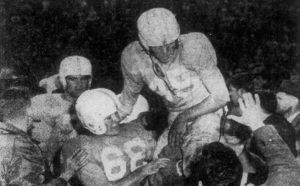




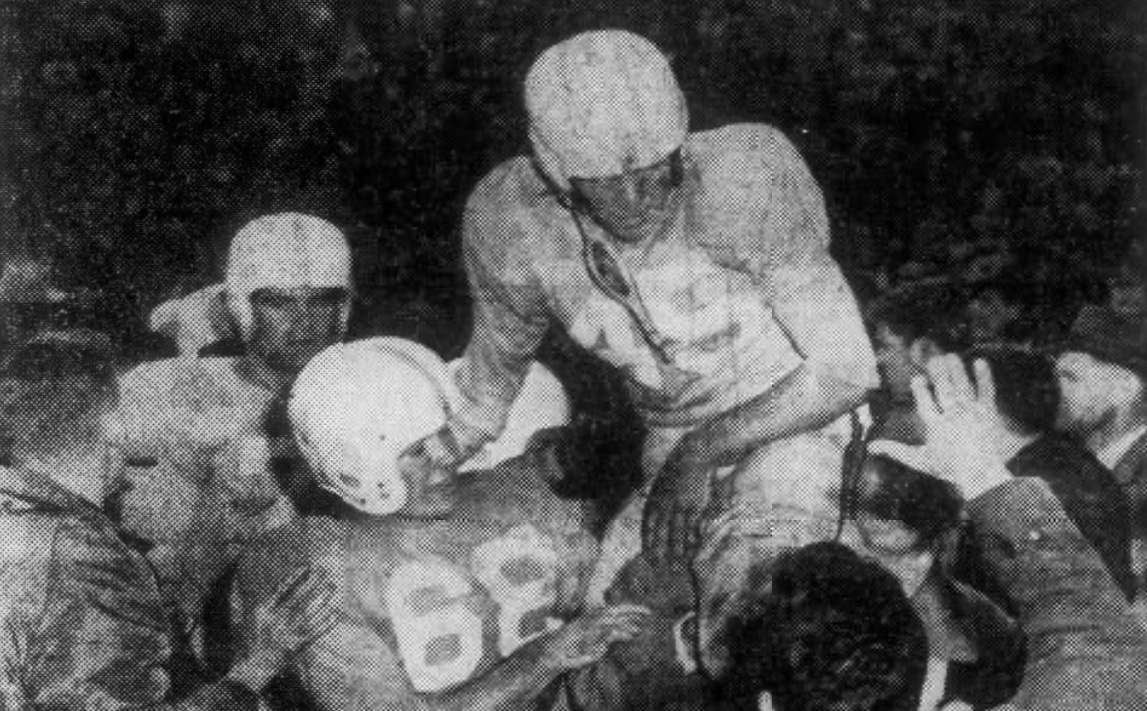
Johnny Majors’ heels rested somewhere around the 20-yard line at Shields-Watkins Field.
Tennessee’s offense was struggling and the Vols were about to give the ball right back to Vanderbilt down one score late in the second quarter on Nov. 26, 1955.
The Commodores awaited the quick-kick, certain Tennessee wouldn’t risk getting stuffed again virtually backed up to its own end zone. Seconds later, they were seeing John “Drum” Majors’ gallantry on full display down the sideline steering towards the other end of the field.
Majors didn’t kick it. He dropped back, then darted a pass to Buddy Cruze, who extended one hand, palmed the ball, bobbled it for several yards and then hauled it in before Charlie Horton knocked him out of bounds at the Vanderbilt 33.
Horton saved a touchdown, but only for a moment. Tennessee scored three plays later on another Majors toss to Cruze, this one for 10 yards and the tie.
It was one of a few tricks the Vols seemingly pulled out of nowhere that afternoon to beat the Commodores, 20-14 and dash their hopes of a Sugar Bowl bid while setting the stage for their own SEC title run a year later.
“Caution and its offense bordering on the timid side in the early stages, Tennessee’s Volunteers went pass-crazy in the fading minutes yesterday afternoon to knock Vanderbilt’s Commodores from the bowl picture in the season’s most spectacular classic,” Ed Harris wrote for the Knoxville Journal.
On a day where Vanderbilt bottled up nearly everything Tennessee tried to push through the line of scrimmage, the Vols flipped the script and began airing the ball around in a revolutionary twist on the same turf where Robert R. Neyland made the single wing offense famous.
The Commodores were favored, entering the final week of the regular season with seven wins and riding a six-game win streak. It put Vanderbilt in line for the Sugar Bowl against Pittsburgh. All it needed to do was beat the Vols.
Tennessee started head coach Bowden Wyatt’s first season with losses to Mississippi State and Duke before recovering with wins over Chattanooga, Alabama, Dayton and North Carolina.
The Vols tied No. 8 Georgia Tech, 7-7 and hiccuped in a 23-0 loss at Kentucky one week before hosting a Vanderbilt team that thumped them 26-0 in Nashville one year earlier.
“Although Vanderbilt entered the game a point and one-half favorite, the Vols were conceded a chance to upset the visitors,” the Knoxville News-Sentinel reported. “Commodore supporters are reported to have brought along big wads of money to back their team, but were not willing to give a point. It is said Tennessee partisans covered considerable Vandy dough at even money.”
Cruze was the cause of the frustration of those Vanderbilt backers. He was especially frustrating for Horton—Vanderbilt’s All-SEC halfback.
He recovered two fumbles and snuffed out a fake kick by dragging down Horton for a 12-yard loss on fourth down. His one-handed grab brought Tennessee back to life. He caught four other passes for 98 yards and two touchdowns—one of them he snatched out of the hands of Horton.
“We played a fine game, and I’m greatly pleased with everyone of my boys,” Wyatt told reporters. “All of them played excellent football, and of course Buddy Cruze and John Majors were simply marvelous. Cruze played as good an individual game as any player I’ve ever seen.”
By clicking "Subscribe to Newsletter", I agree to On3's Privacy Notice, Terms, and use of my personal information described therein.
Twice Tennessee fell behind by a touchdown. Twice they came back to tie it. But as stellar as the combination of Majors and Cruze was, it was Al Carter and Bill Anderson that landed the knockout blow.
It came with three minutes left in the fourth quarter, with the score knotted at 14.
Commodores’ defensive back Don Orr had just exited the game with a dislocated elbow and Horton was shifted to the right side of the field where Cruze was lined up.
Bowden called for Carter on the sideline. He told the reserve tailback to go deep before he raced onto the field.
Carter uncorked a pass to Anderson, who snagged it in stride right in front of Pete Tkac, Orr’s replacement. Anderson raced 43 yards for a touchdown—the dagger.
“Out-charged on the ground and rebuffed at almost every turn by an enterprising, bowl-conscious band of Commodores, Tennessee once again lent credence to that old maxim, ‘If you won’t be whipped, you can’t be whipped,’” Austin White penned for the Chattanooga News-Free Press.
Vanderbilt ended up in the Gator Bowl, instead. Tennessee didn’t get a postseason invite, but the wheels were in motion for an SEC Championship in 1956.
The win opened the way for an 11-game win streak, which included a 6-0 triumph of No. 2 Georgia Tech in what is regarded as one of the greatest games in southern football history the following season.
Majors and Cruze were both named All-Americans, with Majors finishing second in a contested Heisman Trophy race, controversially losing out to Notre Dame’s Paul Hornung.
Anderson, who later served as the football color analyst for 30 years alongside John Ward for the Vol Network, was named team captain in 1957 and was part of the Green Bay Packers’ Super Bowl I win in 1967.
All three were instrumental in Tennessee’s resurgence in the post-Robert Neyland era.
“The way our boys played under pressure was a wonderful thing to see,” Wyatt said. “I’m just as proud of this gang as I can be. Johnny Majors stood out again, but that’s not news anymore. Buddy Cruze did a great job for us.”
© 2026 On3 Media, Inc. All rights reserved. On3 is a registered trademark of On3 Media, Inc.