

Vanderbilt Alpha Chi Omega chapter to close at end of semester
Epstein files mention Vanderbilt professors, former chancellor
Early decision acceptance rate down to 11.9% for Class of 2030
Top 10 love songs of all time
Best of Super Bowl 2026 commercials
VUMC anesthesiologist charged with 15 counts of sexual exploitation
Men’s Basketball: Three takeaways from Vanderbilt’s loss to Tennessee
WU: Lessons from Vanderbilt’s human radiation experiments
Women’s Basketball: Three takeaways from Vanderbilt’s 76-74 upset loss to Georgia
Vanderbilt admits first members of Class of 2030 via early decision I
In the third quarter against unranked Florida, No. 5 Vanderbilt needed something to shift.
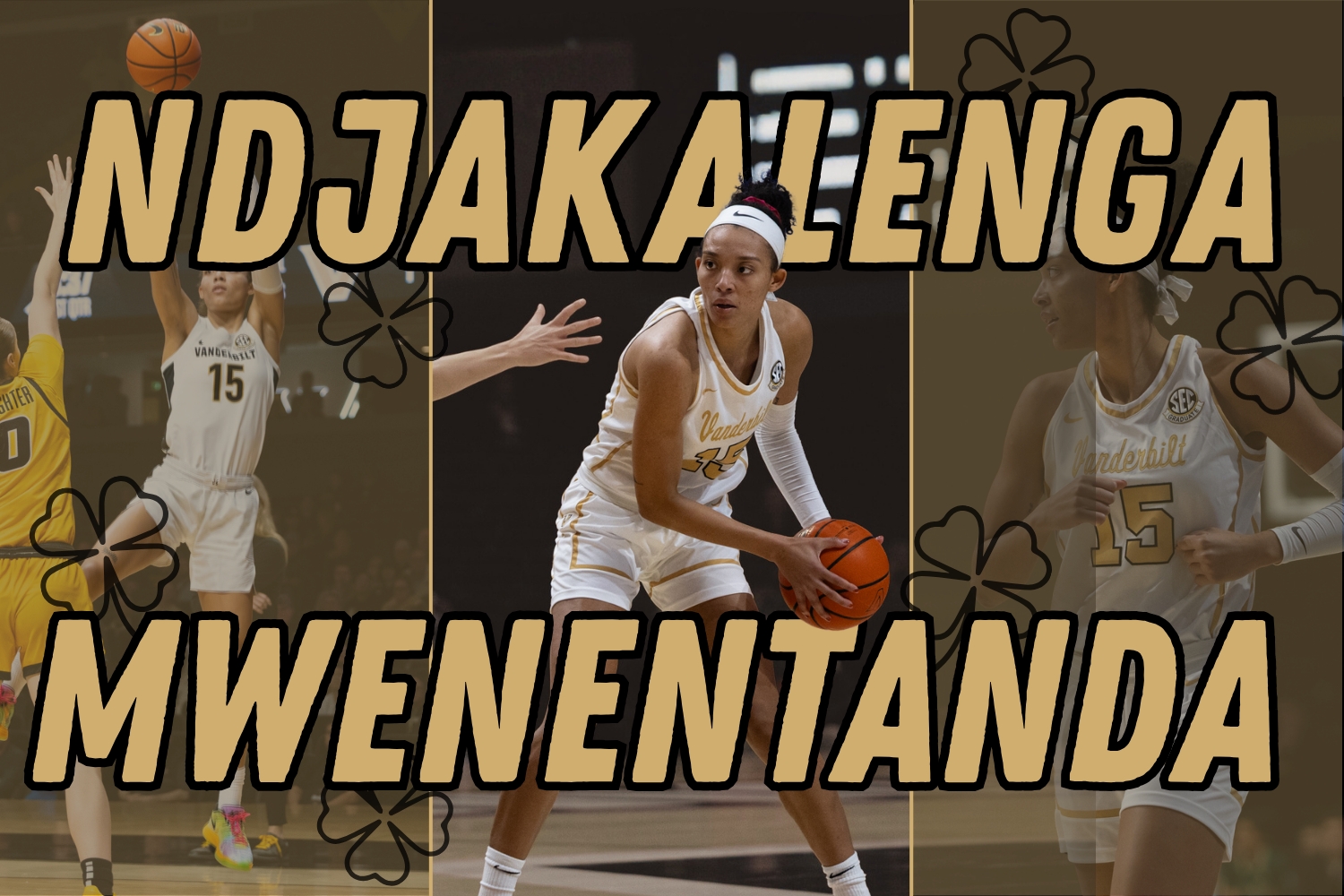
The Commodores had struggled throughout the first half, searching for rhythm and ending the half down nine points. Then, Ndjakalenga Mwenentanda stepped in front of a drive, planted her feet and absorbed contact. Charge.
One possession later, she did it again. Another charge. The whistle changed the tone of the game. Vanderbilt’s bench celebrated, Memorial Gym erupted and momentum tilted. After the game, head coach Shea Ralph pointed to that stretch as the turning point.
“What I love about Ndjakalenga is that she just wants to win,” Ralph said. “It doesn’t matter if she shoots or even touches the ball much. She’ll go after rebounds, defend, run hard — she does everything we ask because she wants to contribute to winning. Some players will get the shine, but you also need the ones willing to do the blue-collar work that doesn’t always show up in the spotlight. Ndjakalenga is a perfect example of that kind of player.”
Mwenentanda’s first name means “gift of luck,” but nothing about her journey — or her role at Vanderbilt — has been accidental.
Mwenentanda’s name comes from her mother’s tribal language in the Democratic Republic of Congo. There is a tribal priest in the Luba tribe who names all the newborns, and Ndjakalenga was the name selected for Mwenentanda. She carries her name with pride.
“I hold a lot of importance in my name because it has a meaning,” Mwenentanda told The Hustler. “I’m okay with people shortening it and stuff like that. But just the fact that I have such a unique name and I was blessed with the kind of life I have, I just feel like my name is another blessing in itself.”
Her mother represented the Democratic Republic of Congo in basketball at the 1996 Summer Olympics in Atlanta and played college basketball at Old Dominion and Nebraska-Kearney. She has two younger brothers and one older sister. Growing up, they were all athletes.
“I started [playing] basketball in second grade and started competing a bit more competitively in third and fourth grade,” Mwenentanda said. “I am really close-knit with my whole family, and training for basketball was just another workout day with the family.”
For Mwenentanda, the pandemic marked a turning point. As a sophomore in high school during COVID-19, she had time to reflect on what she wanted long-term.
“I was still recruited when I was a freshman in high school, but in COVID, you have all this free time. You have time to reflect, you have time to train, and I was like, ‘Why not keep going with basketball?’” Mwenentanda said.
The former four-star recruit and 2022 South Dakota Gatorade Player of the Year ultimately chose Texas because of its resources and upward trajectory — head coach Vic Schaefer had been to back-to-back Elite Eights with Mississippi State. Texas being in the Big 12 at the time also allowed her family to travel to certain conference games. NIL did not exist during her recruitment, so it was not a part of the decision-making process.
“I just felt like being in that kind of winning program would be exciting to be a part of,” Mwenentanda said. “The recruiting process for me in high school — luckily because there was no NIL — was really about building connection and finding the right fit without having to worry about the attraction of money.”
At Texas, she experienced high-level postseason play. During the 2025 NCAA Tournament, she started in the Sweet 16, Elite Eight and Final Four after having back-to-back double-digit scoring performances in the first two rounds. Ralph recruited Mwenentanda to Vanderbilt because she has been exactly where the Commodores want to go.
“She has had that experience and has had critical moments as a player, making sure Texas had success in the NCAA tournament and the Final Four,” Ralph said of Mwenentanda at the start of the season. “She has a leadership role on our team because she has been there. In the locker room, on the court, communication, trust, accountability, she brings all those things with the experience.”
After earning her undergraduate degree in psychology, Mwenentanda entered the transfer portal. She said she wanted to experience a different style of college basketball, and she found the right fit at Vanderbilt. Ralph and her staff had recruited her in high school, which made the transition feel natural.
“I just really wanted to try something new,” Mwenentanda said. “I felt like I just needed a change of scenery. Coach Ralph and the other coaches had recruited me in high school, so they sort of knew my path and how much more I could grow. I really was big on relationships because of the short time period when it came to picking a school. It would be hard just to pick a different coach that might have not known me, or I might not have known them.”
Mwenentanda immediately stepped into a starting role for the Commodores, averaging 7.6 points, 3.3 rebounds, 1.0 assists and 1.1 steals per game. She prioritizes the intangibles, defense, rebounding and being a leader on the floor.
“We’re a really defensive-minded team because everybody on the team can score, but I just try to do my job every game,” Mwenentanda said. “Thanks to God for having the athletic ability, defense has been one of the main things that I find comes naturally. Obviously, it’s still a mind game in a way, but defense is always the thing that’s most reliable in my game.”
Offensively, Mwenentanda believes she has grown significantly. Beyond making shots, she focuses on making the right reads and using her basketball IQ on both ends of the court. She credits the coaching staff for pushing her in practice and helping refine her decision-making. Mwenentanda believes one of Vanderbilt’s greatest strengths is its balance.
“Mikayla Blakes is a phenomenal player and she’s surrounded by teammates who really trust her and care about her but Mikayla is able to put trust in us because everyone on the floor and people who come off the bench are able to score,” Mwenentanda said. “There’s always something positive to look from it from our team because everyone can impact the game in some way, shape or form.”
Her previous winning experience has also shaped the way she leads. In difficult stretches, she leans on positivity and perspective to steady the group. She emphasizes that adversity is part of the process and something every successful team must navigate together.
“Trust is really important in building a winning team because you need to be able to get through tough times by building that trust,” Mwenentanda said. “I think that winning experience does help, especially when we may be struggling. Bringing those positive vibes and reminding everyone that it’s all for a reason is something I try to emphasize as a leader.”
That team-first mindset was shaped in part by the players she admired as a child. Growing up, Candace Parker was the standard for Mwenentanda. She followed Parker closely during her time with the Los Angeles Sparks through the end of her professional career and admired the way she dominated the game with size, skill and versatility.
“I looked up to Candace Parker,” Mwenentanda said. “We had similar stature. She was just an amazing freak of nature, and it was just incredible what she was able to do.”
Mwenentanda still has a large poster of Parker hanging in her childhood home. She has since met her idol a few times, including during her time at Texas when the WNBA star visited one of her former coaches.
“I was like, ‘How is Candace Parker here? She doesn’t even like Texas.’ It was really cool,” Mwenentanda said. “I was fan-girling, I can’t even lie. I never got to see her play [in] college, but I was watching her when she was a pro.”
She also points to Maya Moore as someone who reshaped her understanding of what it means to be a professional athlete. Moore’s impact extended far beyond the court, especially during COVID-19, when she spearheaded Black Lives Matter initiatives and helped advocate for her husband’s release from wrongful incarceration.
“Along with Candace, Maya Moore was somebody I looked up to,” Mwenentanda said. “When she made such an impact on the community and helped her husband with his false incarceration, I was just like, ‘That’s an amazing woman right there.’”
The lessons she drew from her role models continue to shape how she handles adversity. When shots aren’t falling or games don’t go as planned, she narrows her focus to what she can control.
“I focus on what I can control,” Mwenentanda said. “Yeah, it might be a bad night for me, but it could be a good night for somebody else. There are still ways I can be a great teammate. Also watching film after whatever went wrong, there’s always opportunity to grow, look at the positives and also look at what you can fix.”
In today’s world, where social media is prominent, Mwenentanda advises younger athletes not to compare themselves to others. She believes constant comparison in terms of points scored, recruitment offers, etc., can become a distraction if athletes aren’t careful.
“I truly think you just have to trust the process and keep working,” Mwenentanda said. “You don’t have to post everything. Use your platform in a smart manner. It’s okay to be humble and just keep grinding.”
Mwenentanda practices these habits herself. On game days especially, she protects her mindset by limiting her time online.
“I try to stay off of [social media] the day of games,” she said. “If there’s something I don’t want to see, I’ll block it or press ‘Not Interested.’ It’s my internet. I just make sure I’m not overindulging and feeling negative about myself.”
Off the court, Mwenentanda is just as intentional about protecting her energy. Whether it’s stepping outside for fresh air or unplugging with a show, music or a puzzle, she prioritizes finding ways to reset.
“I really do like going outside and just enjoying nature, whether that’s going on a walk or just sitting outside,” Mwenentanda said. “When things are stressful, that’s a place I can go to, even in my head, to just reset.”
That same intentional approach extends beyond the court and into the classroom. Mwenentanda enrolled in Vanderbilt’s one-year graduate program in medicine, health, and society, where she will obtain a Master of Arts in social foundations of health. While her primary goal is declaring for the WNBA Draft, she remains open to possibilities in business or sports psychology.
“A lot of people value a degree from Vanderbilt. If I go down the path of sports psychology, it shows that I still have some kind of experience within the health area,” Mwenentanda said. “The main path that I’m focused on now is going pro.”
Mwenentanda hopes to pursue a professional career both in the United States and overseas. She said her experience playing in Paris at the start of her Vanderbilt journey reaffirmed her desire to compete internationally again.
But for now, Mwenentanda is focused on the present — helping No. 5 Vanderbilt make a deep run in the NCAA tournament. Her name means “gift of luck,” but the impact she continues to make in Memorial Gym has little to do with chance. Possession by possession, charge by charge, Mwenentanda is proving that what looks like luck is often just preparation meeting the moment.
The official student newspaper of Vanderbilt University
Cancel reply
Your email address will not be published.
Subscribe to Updates
Get the latest creative news from FooBar about art, design and business.
Ndjakalenga Mwenentanda: A gift of luck – The Vanderbilt Hustler