
College Sports
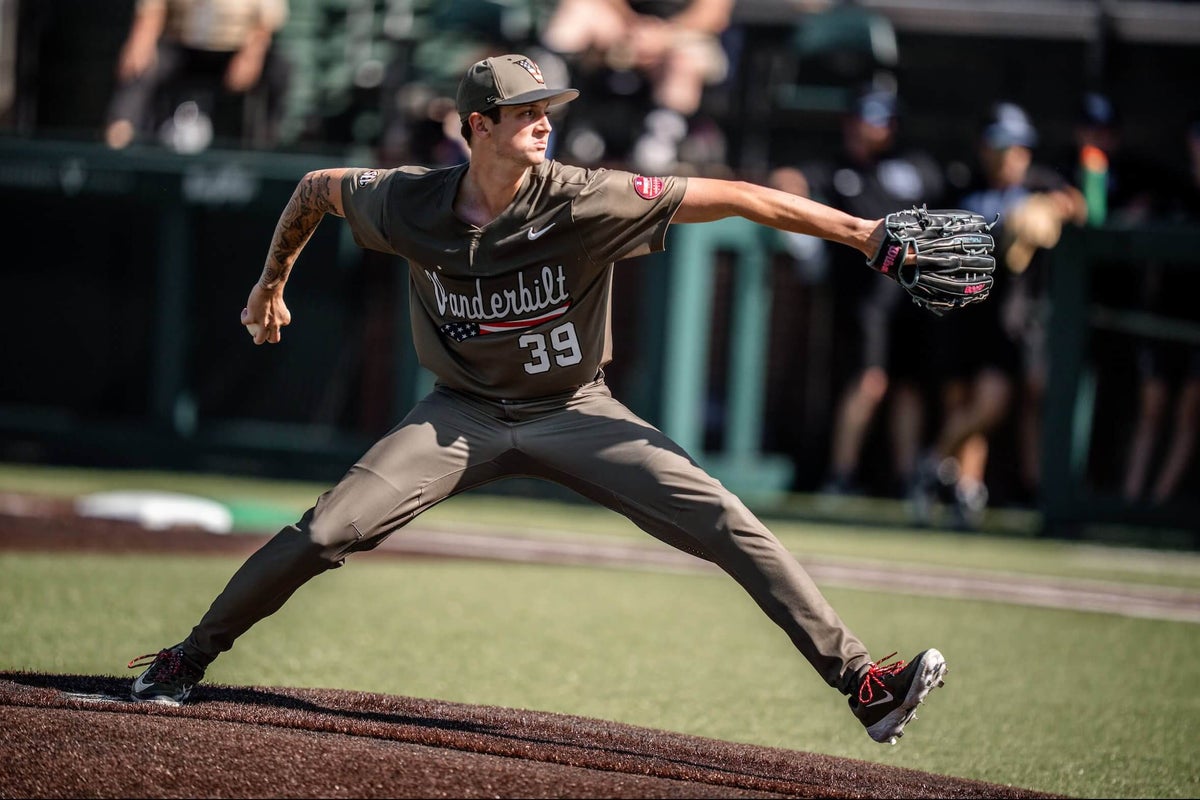
Connor Fennell struck out 40.8 percent of the batters he faced in 2025. Ethan Hunt / Vanderbilt University
Scott Brown didn’t talk about arm slot. Didn’t mention analytics or deception. Nope, the first thing that popped into his head to explain what makes Vanderbilt junior right-hander Connor Fennell so effective was this:
“He flat-out hates hitters,” said Brown, the Commodores’ longtime pitching coach.
And hitters hate him, too — even the ones on his own team.
Advertisement
“He kind of drives all of us a little nuts. You have seen some of his antics on the mound,” said Vanderbilt slugger Braden Holcomb, referring to Fennell’s unusually brisk pace. “As a hitter, you are trying to go up there with a plan every at-bat, and you can get a little rushed, scattered when someone is moving that fast.”
Know what else annoys hitters? They can’t seem to square him up — if they make contact at all — despite his relative lack of velocity. In an era when most power-conference pitchers are throwing in the low-to-mid 90s (at least), Fennell’s fastball in 2025 averaged 87.6 mph, the fourth slowest in the SEC (min. 100 pitches thrown), according to TruMedia.
That didn’t prevent him from posting eye-popping numbers in his first year after transferring from Dayton. He went 6-0 with a 2.53 ERA and allowed only 33 hits in 53 1/3 innings. His most impressive stat: a strikeout rate of 40.8 percent that ranked third in the nation behind flamethrower (and fellow New Hampshire native) Liam Doyle of Tennessee and Antoine Jean of Houston.
“He is what we would call kind of a metrics darling,” said ESPN/SEC Network analyst Chris Burke, who played six years in the major leagues. “The release height and the shape of his fastball is so unique relative to the norm for hitters that the ball is just … I think in layman’s terms, it just reacts differently than the vast majority of fastballs. And so he gets swings and misses with velocity that we are told you’re not supposed to get swings and misses with.”
The release height Burke references is part of Fennell’s secret sauce. On his fastball, which he threw 53 percent of the time in 2025, his average release point was 4.59 feet off the ground, among the lowest in the nation (in the third percentile). His extension is also an outlier; his average release point on his fastball was 6.76 feet in front of the rubber (in the 97th percentile). The result is a pitch with a flatter trajectory that remains in the batter’s swing path for a shorter time.
Advertisement
Combine those metrics with the ability to throw strikes — Brown calls him a “a command artist” — and a hyper-competitive nature, and the result is the SEC’s most unlikely staff ace.
“There’s a fearlessness with which he goes about his business and an intensity with which he goes about his business,” Burke said. “I think what was cool to observe, seeing him in person, was just how much he’s ready for the fight.”
Burke singled out Fennell’s immediately viral confrontation with Tennessee star first baseman Andrew Fischer in the SEC Tournament as an example.
2025 PitchingNinja “You can Run, but you can’t Hide” Award. 😳🏆
Winner: Connor Fennell
Refusing to step off, during this time out. pic.twitter.com/EjbzfJT2wX
— Rob Friedman (@PitchingNinja) November 15, 2025
“He took this big, long timeout,” Fennell said, “And I wasn’t stepping off the mound. I was waiting for him to get right back in there, just wanted to stay focused, and I’m ready for when you get back in here. So I’m coming right at you.”
Fennell, 6 feet 1 and 183 pounds, is now a recognizable name throughout college baseball, but he isn’t receiving a ton of buzz as a potential early-round pick in the 2026 MLB Draft, no doubt due to his lack of velocity. He is ranked No. 145 overall by Baseball America (which includes high school and college players) and was not in D1Baseball’s ranking of the top 100 college players published in October.
Still, he’s come a long way from his prep days when he was a recruiting afterthought coming out of Londonderry High in New Hampshire and was headed for a post-grad year at The Winchendon School in Massachusetts before Dayton head coach Jayson King came in with a late offer in the summer after his high school graduation.
Fennell was good but hardly great in his one season at Dayton, going 4-4 with a 4.74 ERA, a .261 batting average against and fewer strikeouts than innings pitched. Not exactly numbers that suggested he could be effective in the SEC.
Advertisement
But after Vanderbilt hired King as its hitting coach in June 2024, King convinced Brown and Commodores head coach Tim Corbin to take a look at the skinny kid with the unique delivery.
“So we dove in,” Brown said. “We felt like we could tighten up the changeup and add a little bit of a breaking ball-cutter aspect here just to get something going away from a righty, and we may have something. But I think the biggest thing that kind of drew us towards Connor was coach King’s description of his competitiveness.”
For Fennell, it was a no-brainer. After entering the transfer portal, he took only one recruiting visit.
“This has been my dream school for a while,” he said.
Despite that confidence, Fennell didn’t look the part of an SEC pitcher during his first fall at Vanderbilt.
“It was the most struggle I’ve ever had in the sport of baseball, for sure,” he said. “I got hit around pretty hard, and I wasn’t physically ready for the SEC yet.
“I worked with Brownie, I worked with (analytics coach Tyler) Herb, worked with our strength coach, and just really tried to get as strong as possible, and by the time the preseason came around, I was throwing a little harder and we had developed my stuff to a point where I was able to compete in the SEC.”
Once the season began, Fennell quickly established himself as a trusted arm out of the bullpen. He made his Vanderbilt debut on Feb. 17, throwing two scoreless innings and striking out five in a 3-1 win over Air Force. He didn’t give up a hit in his next four outings, combining for eight strikeouts in 3 1/3 innings. He struck out 13 of the first 19 batters he faced in a Vanderbilt uniform.
He got his first conference start in Vanderbilt’s second SEC series, on a Thursday night against Texas A&M. The Commodores wanted to keep J.D. Thompson, their Friday night starter, on a regular schedule, so Corbin and Brown selected Fennell as the stopgap starter.
Advertisement
“We didn’t know what to expect,” Brown said. “If he can give us two or three innings, we’ll go from there.”
Fennell served up a two-run home run to All-America outfielder Jace LaViolette in the top of the first inning but bounced back and held the Aggies scoreless over the next three-plus innings. His final line: 3 2/3 innings, four hits, two earned runs and eight strikeouts.
From that point on, he was Vanderbilt’s most effective pitcher. In 11 SEC games (seven starts), he allowed only 27 hits in 42 innings and struck out 67 with only nine walks. The highlight was a seven-inning complete-game shutout at Ole Miss in which he allowed three hits and struck out 12 with only one walk.
“That was really fun,” he said. “I was really excited to go pitch in that atmosphere, (9,000) people. I just love when there are that many people rooting against me.”
Fennell finished the 2025 season with three straight relief appearances — throwing a combined 11 shutout innings against Kentucky in the regular-season finale, Tennessee in the SEC Tournament and Louisville in the NCAA Tournament — but will likely be used as a weekend starter when the Commodores open the 2026 season at the Shriner Children’s College Showdown in Arlington, Texas, this weekend.
And when he takes the mound, either Friday against TCU or Saturday against Texas Tech, could we see a bit more velocity on his fastball? “Last season, I topped, I think at 90.6,” he said. “I’ve been sitting at around 90. I hit 91 in the fall, so I’m hoping to keep creeping up as the weather heats up.”
That extra mph might be good for Fennell’s ego, but velocity, at least for him, is a state of mind.
“He acts like he’s throwing 105,” Vanderbilt reliever Miller Green said. “He thinks he’s going to blow it right past you.”
Spot the pattern. Connect the terms
Find the hidden link between sports terms
Play today's puzzle
Mitch Light is a college sports editor for The Athletic. He previously served as the managing editor for The Athletic Nashville and The Athletic Memphis and prior to that was the managing editor at Athlon Sports for 18 years. Follow Mitch on Twitter @MitchLight
Subscribe to Updates
Get the latest creative news from FooBar about art, design and business.
How Vanderbilt’s Connor Fennell became the SEC’s unlikeliest ace: ‘He flat-out hates hitters’ – The New York Times